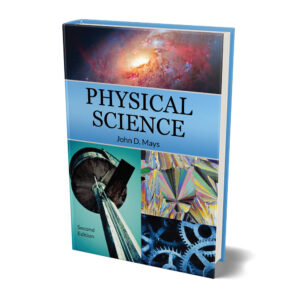
Physical Science (Softcover)

Physical Science is an excellent text for middle school-aged students.

ISBN 978-0-9981699-4-1

SKU: 2215 Category:

Description

** Note: This book is produced by print-on-demand service and may take 2-4 weeks to ship.

View Errata | View Tips and Tools

Combining mastery-learning and a unique textbook philosophy, this physical science course helps students break the Cram-Pass-Forget cycle so that they truly learn and retain course material.

This physical science text is designed for grades 6-8. Physical Science is beautiful and organized around the principles guiding all Centripetal Press texts: Mastery, Integration, and Wonder.

Good science instruction should draw students upward into the adult world of scientific inquiry. We start with a proven mastery-learning paradigm: through a carefully crafted program, students continually learn and build on their learning, re-encountering key concepts and practicing scientific skills so that they become settled in the student’s mind.

Mastery learning requires ongoing review even as new material is presented. It also takes culling the material down to a manageable amount that an average student can actually master in the course of a year. This means that Centripetal texts are serendipitously smaller than the usual 8-10 pound tomes. Better, more enduring learning takes place when the student goes deeper with a moderate amount of material rather than trying to cover too many topics too rapidly or shallowly.

microscope

Each chapter begins with a list of quantifiable learning objectives and important vocabulary. Chapters also include periodic Learning Checks which provide a moment to stop and review. There are 12 “Experimental Investigations” included with the book, not in a separate manual, with instructions and materials listed. The teacher’s version of the experiment is on the Digital Resources. Some experiments are demonstrated on Youtube videos. Some experiments require the use of special “widgets” which are available for purchase in the Special Parts Kit. These can be fashioned at home by a handyman if one is available; schematics are provided in the Digital Resource to make them.

Integration is the inclusion of material across subjects relevant to the topic in the text: the history behind the science, grade-level mathematics, written and verbal English language skills, and measurement skills. Physical Science in particular even includes some discussion of epistemology (what kind of knowledge science gives us). References from the humanities are used where appropriate to add greater dimension, to humanize and decompartmentalize science, references to art, music, architecture, technology, and literature.

Finally, this book strives to convey a sense of wonder at the amazing universe. This text devotes space in chapters 4 and 7 to a discussion about the presence of order in the universe. It also discusses the nature of theories, facts, truth, hypotheses, and the nature of scientific knowledge. 

Physical Science is beautiful inside and out. With a mature, developed sense of aesthetics, this book is tidy and attractive. Students love the personal style of the narrative in which the author concisely and accurately explains the concepts with evident wonder and excitement at the marvels of the world.


Additional information

Weight 1.6 lbs
ISBN

Weight

Binding

Pages

Table of Contents

Chapter 1 Matter and Atoms

1.1 The Three Most Basic Things
1.2 Atoms
1.3 Electrons
1.4 The Development of Atomic Theory

Chapter 2 Sources of Energy

2.1 What Is Energy?
2.2 Where Is the Energy?
2.3 Sources and Forms of Energy
Electromagnetic Radiation
Kinetic Energy
Potential Energy
Gravitational Potential Energy
Chemical Potential Energy
Thermal Energy
Nuclear Energy
Experimental Investigation 1: Kinetic Energy

Chapter 3 Conservation of Energy

3.1 The Law of Conservation of Energy
3.2 Mass-Energy Equivalence
3.3 Heat and Heat Transfer
3.4 Work
3.5 Internal Energy
3.6 Summary: Where Is the Energy?
Experimental Investigation 2: Heat Transfer by Conduction

Chapter 4 Order and Design in Nature

4.1 Why Are There Laws of Nature?
4.2 Order and Structure in Nature
4.3 The Remarkable Universe
Conditions Necessary for Life
Other Remarkable Observations
Conditions Necessary for Exploration

Chapter 5 Forces and Fields

5.1 The Four Forces
The Gravitational Force
The Electromagnetic Force
The Strong Nuclear Force
The Weak Nuclear Force
5.2 What Are Fields?
The Gravitational Field
The Electric Field
The Magnetic Field
5.3 The Electric Field
5.4 The Magnetic Field
5.5 The Gravitational Field
Experimental Investigation 3: Electrostatic Attraction

Chapter 6 Substances

6.1 Atoms, Molecules and Crystals
Molecules
Crystals
6.2 The Substances Family Tree
6.3 Elements
6.4 Compounds
6.5 Mixtures and Solutions
Experimental Investigation 4: Growing Crystals

Chapter 7 Science, Theories and Truth

7.1 Science Is Mental Model Building
7.2 The Cycle of Scientific Enterprise
Theory
Hypothesis
Case Study: Part 1
Experiment
Case Study: Part 2
Analysis
Case Study: Part 3
Review
Case Study: Part 4
7.3 Facts and Theories
7.4 Experiments and the Scientific Method
7.5 Truth
7.6 Ways of Knowing Truth
Direct Observation
Valid Logic
7.7 Relating Scientific Knowledge and Truth
7.8 Summary: The Nature of Scientific Knowledge

Chapter 8 Measurement and Units

8.1 Science and Measurement
8.2 The International System of Units
8.3 Metric Prefixes
8.4 Unit Conversions
8.5 Calculating Volume
Experimental Investigation 5: Determining Volume

Chapter 9 Properties of Substances

9.1 Pressure and Temperature
9.2 Temperature, Pressure and Volume
Temperature
Pressure
Volume
9.3 Phases of Matter
9.5 Calculating Density
9.6 Chemical Properties
Experimental Investigation 6: Determining Density
Experimental Investigation 7: Heat and Fusion

Chapter 10 Force and Motion

10.1 A Brief History of Motion Theory
10.2 Velocity
10.3 Acceleration
10.4 Inertia and Newton’s Laws of Motion
Inertia
State of Motion
Newton’s First Law of Motion
Newton’s Second Law of Motion
Newton’s Third Law of Motion
Experimental Investigation 8: Inertia and Force

Chapter 11 Compounds and Chemical Reactions

11.1 Tools for Chemistry
Chemical Equations
Ions and Polyatomic Ions
Acids and Bases
11.2 How Compounds Form
Main Goal #1
Main Goal #2
11.3 Chemical Reactions
Salts
Combustion Reactions
Oxidation Reactions
Redox Reactions
Prescription Reactions
Acid-Base Reactions
Experimental Investigation 9: Observing Chemical Reactions

Chapter 12 Waves, Sound and Light

12.1 What is a Wave?
12.2 Types of Waves
12.3 Common Behaviors of Waves
Reflection
Refraction
Diffraction
12.4 Sound and Human Hearing
Experimental Investigation 10: Refraction

Chapter 13 Electricity

13.1 The Nature of Electricity
13.2 Static Electricity
13.3 How Electric Current Works
13.4 DC Electric Currents and Ohm’s Law
13.5 Series and Parallel Circuits
Experimental Investigation 11: Parallel and Series Circuits

Chapter 14 Magnetism and Electromagnetism

14.1 Magnetism and Its Cause
14.2 Ampère’s Law
14.3 Faraday’s Law of Magnetic Induction
Experimental Investigation 12: Magnetic Field Strength

Appendix A  Making Accurate Measurements

A.1 Parallax Error and Liquid Meniscus
A.2 Measurements with a Meter Stick or Rule
A.3 Measurements with a Triple-Beam Balance
A.4 Measurements with an Analog Thermometer

Appendix B  Prediction-Result Difference Ratio

Appendix C  Glossary

Appendix D  Image Credits

Appendix E  References

Index

Sample Pages

You may also like…